
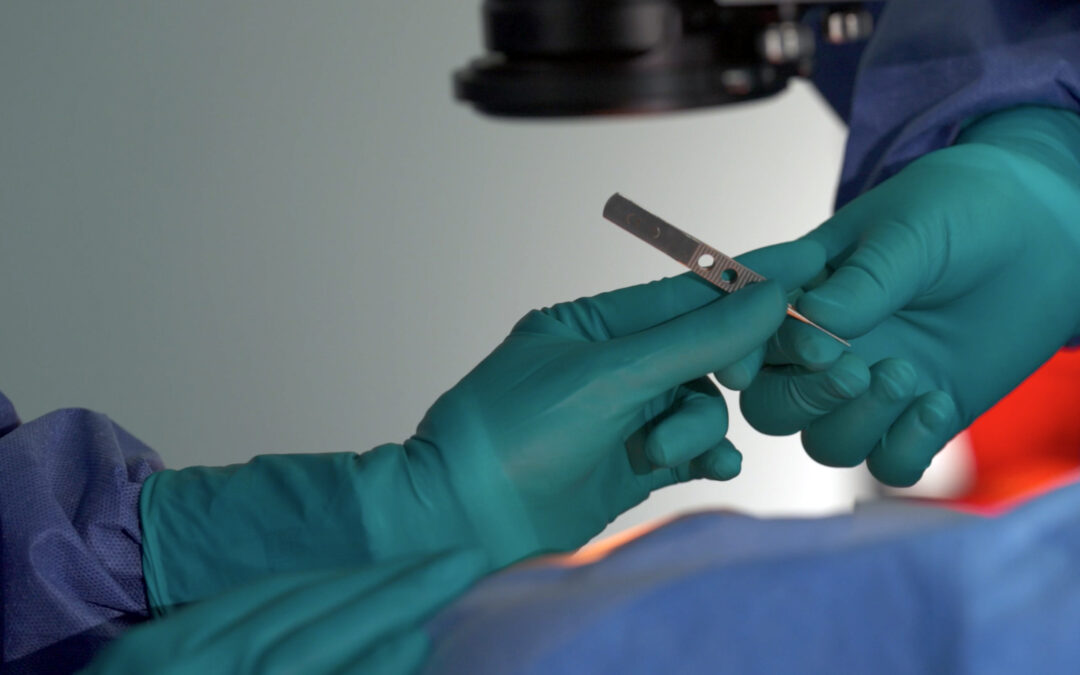
Forceps are among the most fundamental ophthalmic instruments used across anterior and posterior segment procedures. They appear in nearly every surgical tray, from routine cataract operations to complex corneal grafts – yet the differences between instrument types are far from trivial. A variation of fractions of a millimetre in tip geometry, jaw texture, or shaft alignment can meaningfully affect control during a procedure where precision is non-negotiable.
For surgeons, theatre leads, and procurement teams alike, understanding the distinctions between forceps types is essential. Instrument selection directly influences how tissue is handled, how sutures are managed, and how consistently a surgical team can perform across high-volume lists. This article provides a structured overview of the main types of ophthalmic forceps, the design factors that matter, and the considerations that inform sound procurement decisions.
Why Forceps Design Matters in Ophthalmology
Ophthalmic surgery operates at a scale that demands microsurgical precision. The anterior segment structures involved – corneal endothelium, anterior lens capsule, iris, and conjunctival tissue – are highly sensitive to mechanical stress. Inappropriate grip, misaligned tips, or excessive instrument weight can introduce trauma that would be inconsequential in other surgical specialties but carries significant implications in eye surgery.
Grip texture matters in direct proportion to tissue sensitivity. A jaw surface that is too aggressive risks tearing delicate tissue; one that is insufficiently textured may fail to hold securely under the fine control required for a controlled capsular tear or suture placement. Balance and weight distribution affect fatigue and tactile feedback during longer procedures. Tip alignment – the point at which both jaws meet precisely when closed -determines whether the instrument will perform as designed or introduce micro-movement that the surgeon must compensate for.
These are not abstract specifications. They translate directly into the conditions a surgeon encounters at the operating table.
Common Types of Ophthalmic Forceps
Capsulorhexis Forceps
Capsulorhexis forceps are used in cataract surgery to create a continuous circular tear in the anterior lens capsule – a step that directly influences IOL centration and postoperative outcomes. Their fine tips allow the surgeon to initiate the capsule tear and maintain controlled directional movement throughout.
Two primary mechanical designs are widely used. The Utrata (direct-action) design uses straight or curved shafts with tips that open as the handles are separated. The incision size constrains tip opening, making this design better suited to larger incisions, typically 2.2mm or greater. Cross-action designs, including micro-incision variants, use a scissor-like pivot mechanism that allows tip movement independently of incision width – enabling use through incisions as small as 1.5mm in some configurations. Micro-capsulorhexis or MICS (Micro-Incision Cataract Surgery) forceps extend this further, with narrower shaft profiles designed specifically for sub-2mm incisions.
Surgitrac offers a range of capsulorhexis forceps in both straight and curved configurations, available as single-use or reusable instruments.
Tying Forceps
Tying forceps are used for suture management and knot placement. Their defining characteristic is smooth jaw tips – free of ridges, serrations, or teeth. This is not a matter of preference. When rotating sutures, any forceps with textured or toothed jaws risk cutting newly placed suture material, particularly fine gauges such as 10-0 nylon. The smooth tips close with precision sufficient to grasp delicate suture material securely without damaging it.
Because of this jaw design, tying forceps are unsuitable for tissue manipulation. They lack the grip texture needed to handle ocular tissue reliably, and their delicate tips are not designed for that purpose. They are purpose-specific instruments.
Corneal Forceps
Corneal forceps are designed to handle corneal tissue with minimal trauma. Their jaw profiles are configured to provide an atraumatic grip – sufficient to secure the tissue for repositioning, suturing, or dissection, without applying forces that could damage endothelial cells or distort the corneal structure. They are used in procedures including penetrating keratoplasty, DMEK, DSAEK, and corneal suturing following trauma.
The geometry of the tips and the degree of jaw curvature vary between instruments intended for corneoscleral rim handling versus those used within the anterior chamber. Procurement teams should ensure that the specific variant selected corresponds to the intended procedure.
Dressing and Utility Forceps
Dressing and utility forceps – including Adson and Bishop-style instruments – serve a broader range of functions in anterior segment procedures. They are used for general tissue handling, wound management, and draping. Available in toothed and non-toothed configurations, the choice of jaw texture depends on the tissue type and the degree of grip security required. Serrated jaws provide reliable grip on firmer tissues; non-toothed versions are appropriate where surface trauma must be minimised.
Single-Use vs Reusable Forceps
The decision between single-use and reusable ophthalmic forceps is a procurement and clinical governance consideration as much as a cost one.
Single-use forceps offer a defined sterility assurance level from the point of manufacture to the point of use. Each instrument arrives in a known condition – tips aligned, surfaces intact, and free of reprocessing-related wear. This eliminates the variability that accumulates over multiple reprocessing cycles and removes the reprocessing burden from theatre and sterile services teams.
Reusable forceps require validated decontamination and sterilisation protocols, inspection between uses, and periodic withdrawal when wear is detected. Properly maintained, they can deliver consistent performance across many procedures. The operational costs of reprocessing -including staff time, cycle validation, and consumables- should be factored into any comparison with single-use alternatives.
The practical argument for single-use instruments often centres on tip alignment and surface integrity. Fine ophthalmic tips are susceptible to micro-damage and burr formation with use. Once tip alignment deteriorates, the instrument no longer performs as designed, and the risk of inadvertent tissue contact or suture damage increases.
Both formats have a legitimate place depending on procedure type, volume, and institutional infrastructure.
Material and Manufacturing Considerations
The performance of ophthalmic forceps is directly linked to the quality of their manufacture. Stainless steel remains the standard material for reusable instruments, with grade selection influencing corrosion resistance, hardness, and the capacity to hold a precise edge or tip geometry through repeated sterilisation cycles. Titanium is used in certain high-specification instruments for its combination of rigidity, low weight, and biocompatibility.
Manufacturing precision determines tip alignment accuracy – how consistently the jaws close to the same point across every unit in a production batch. Batch consistency matters at scale: a theatre procuring instruments in volume needs confidence that the 50th unit from a batch performs identically to the first. This requires controlled production environments, defined quality inspection stages, and robust lot traceability systems.
These factors are not visible in a product photograph but become apparent in surgical performance over time.
Procurement Considerations for Forceps Selection
Procurement teams reviewing ophthalmic forceps specifications should consider the following:
• CE marking: All surgical instruments placed on the EU or UK market must carry a CE mark, indicating that the device has undergone a conformity assessment and meets applicable safety and performance requirements under the Medical Devices Regulation (EU MDR 2017/745 or UK equivalent).
• ISO 13485 certification: This international standard specifies quality management system requirements for organisations involved in the design and manufacture of medical devices. Certification indicates that a manufacturer operates under documented and audited quality processes.
• Batch and lot traceability: Instruments should be identifiable to a specific production batch for post-market surveillance and adverse event reporting purposes.
• Availability in both single-use and reusable formats: Theatre teams may require different configurations for different procedure types. A supplier able to provide both formats simplifies the supply chain.
• Procedure packs: Many ophthalmic procedures require a defined set of instruments used together. Procedure packs that include pre-selected, compatible instruments can reduce preparation time and procurement complexity.
• Technical documentation: Surgeons and procurement leads should have access to instrument specifications, Instructions for Use (IFU), and reprocessing guidelines where applicable.
• Surgeon preference accommodation: High-volume lists may require consistency across a defined instrument configuration preferred by the operating surgeon. Suppliers should be able to accommodate specific handle designs, tip lengths, or shaft curvatures.
Risk Management and Quality Assurance
Instrument-related risk in ophthalmic surgery is concentrated in two areas: micro-damage and misalignment. Burr formation on fine instrument tips – whether from manufacturing defect or reprocessing wear – can affect grip performance and, in rare cases, introduce debris risk. Tip misalignment changes the closing geometry of the instrument, altering the force profile applied to tissue or suture.
The most reliable mitigation is a validated manufacturing process, rigorous incoming inspection, and documented quality control at each production stage. For reusable instruments, this extends to the decontamination and inspection steps performed between procedures. Reprocessing guidelines issued by the manufacturer should be followed precisely; substituting alternative methods without validation introduces variables that cannot be accounted for in the original device specification.
Quality standards such as ISO 13485 are designed to create the documented framework within which these controls operate.
How Surgitrac Supports Forceps Procurement
Surgitrac Instruments is a CE-marked manufacturer of ophthalmic surgical instruments, operating under an ISO 13485:2016 certified quality management system. Its ophthalmic forceps range includes capsulorhexis, tying, fixation, corneal, and utility instruments, available in both single-use and reusable formats. All instruments are batch and lot identifiable in line with internationally recognised standards. Surgitrac supplies NHS and international healthcare systems, and its compliance documentation – including Declarations of Conformity, ISO certificates, and reprocessing guidelines – is available via its Quality & Credentials page. Procedure packs incorporating forceps are also available for a range of anterior segment procedures.
Explore Surgitrac’s range of ophthalmic forceps or contact our team to discuss your instrument requirements.


